Fashion brands spend enormous effort improving product descriptions, photography, and marketing campaigns. But one of the biggest SEO opportunities in fashion e-commerce is often overlooked: structured product attributes.
Search engines, filters, recommendation engines, and on-store search all rely on structured product data. When important product and design attributes are missing or inconsistent, valuable product information gets lost, and never reaches the shopper, or search engines.
Many of these attributes are visually identifiable from the product imagery that the brands already produce, which makes the product images one of the brand’s most valuable assets, more than they may even realize. We’ll get back to that further along in this post.
In the mean time, here are 50 product attributes every fashion e-commerce store should have to best structure pages to improve discoverability, filtering, SEO and GEO.
Core Product Identification
These attributes define the fundamental identity of a product, and some are derived from visual features, while others are typically managed in the store backend.
Visually identifiable attributes
•Product type (dress, shirt, jacket, pants)
•Product subtype (mini dress, maxi dress, cropped jacket)
•Silhouette
•Garment length
•Sleeve length
•Neckline
•Shoulder style
Typically managed by the store
•Brand
•Season
•Gender
Attributes such as collection, SKU, and style name are usually handled in the store or PIM system rather than derived from imagery.
Fit and Structure
Fit is one of the most common ways customers search for fashion products.
Structuring these attributes helps both SEO and product filtering.
•Fit (slim, relaxed, oversized)
•Waist rise
•Leg shape
•Hem Typs
•Sleeve shape
•Collar type
•Closure type
•Waistband style
•Layering structure
•Garment construction details
These attributes describe how the garment is built and how it sits on the body.
Materials and Fabric Characteristics
Material searches are extremely common in fashion e-commerce.
Customers frequently search for products based on fabric type or feel.
•Fabric type
•Material composition
•Knit or woven
•Fabric texture
•Fabric weight
•Stretch level
•Lining
•Padding or insulation
•Sheerness
•Surface finish
Many of these characteristics can be inferred visually or combined with supplier data.
Visual Characteristics
Visual attributes play a huge role in both search and product filtering.
•Color
•Color family
•Pattern
•Print type
•Embellishments
•Distressing
•Wash type (denim)
•Transparency
•Shine or matte finish
•Surface texture (smooth)
These attributes are often clearly visible in product imagery but are frequently missing from structured product data.
Functional and Design Features
These attributes describe practical or design-specific features that customers often search for.
•Pockets
•Adjustable elements
•Belt loops
•Slits
•Layering components
•Reversible design
•Detachable elements
•Thermal or weatherproof properties
•Breathability
•Care instructions
These features help customers better understand how a garment functions.
Why Structured Attributes Matter for SEO
Most fashion stores store product knowledge across multiple places:
•Product imagery
•Design briefs
•Merchandising spreadsheets
•Manufacturer or Supplier documentation
•Product tags and shipping documents
•Product descriptions and titles
•PIM system
But search engines can’t easily interpret unstructured information.
When attributes are structured properly, product pages can rank for far more specific search queries. For example, instead of ranking only for black dress, a structured product page might rank for:
•Black satin mini dress
•Sleeveless satin evening dress
•Fitted black cocktail dress
•Black sleeveless party dress, or even
•Black satin sleeveless princess neckline mini dress with side zip closure and front slit pockets
Structured attributes enable thousands of long-tail combinations automatically.
The Real Challenge: Extracting Product Attributes
The problem isn’t knowing which attributes matter. The problem is capturing them consistently. Manually structuring dozens of attributes per product is time-consuming, especially for fashion brands launching hundreds or thousands of products each season. And much of the information needed to describe a product is already visible in the product imagery.
Where Automation Changes the Workflow
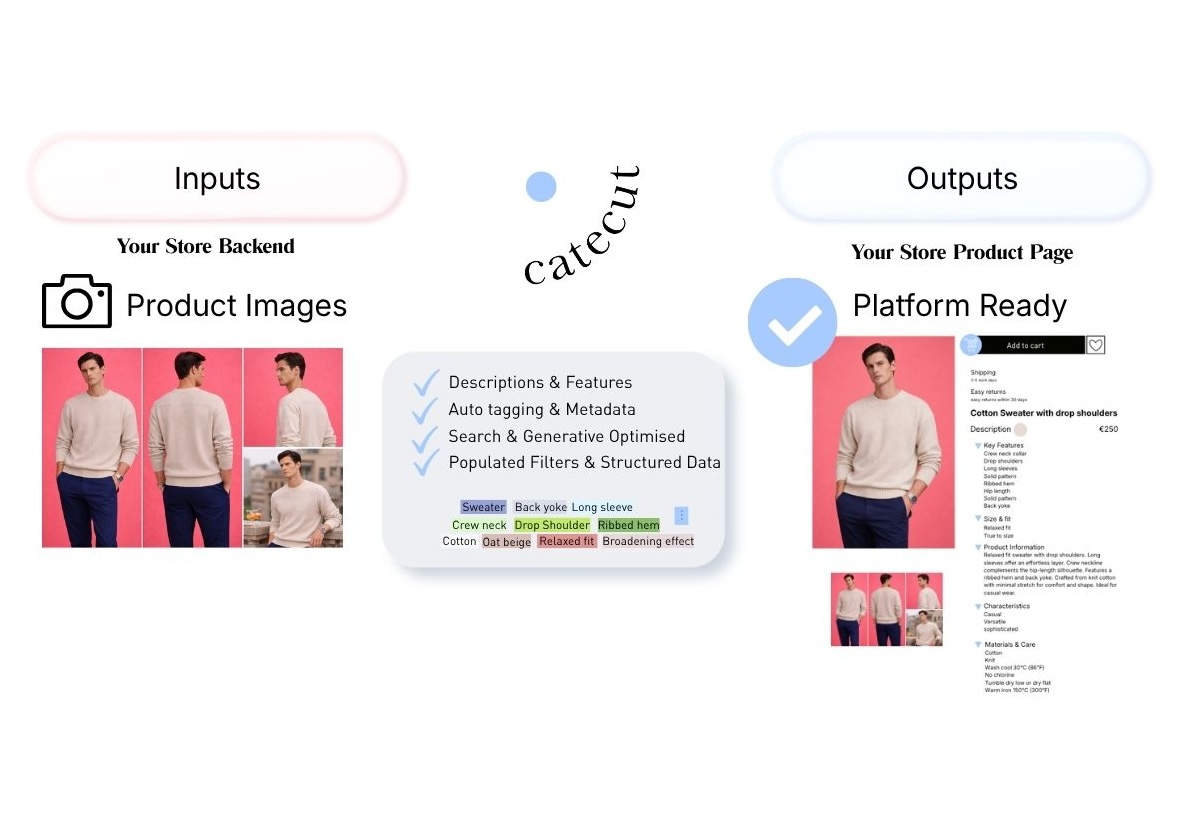
Instead of manually tagging products, new approaches to automation focus on analyzing product imagery. From product images, technology can detect attributes such as:
•Product type
•Garment length
•Sleeve length
•Neckline
•Silhouette
•Pattern
•Fabric characteristics
These attributes can then be structured automatically and returned directly to the store backend.This allows brands to structure far more product data without increasing manual work.
How Catecut Approaches Product Data
Catecut focuses on turning product imagery into structured product attributes that can be used directly in e-commerce platforms. Instead of introducing another complex system, Catecut acts as a lightweight layer that:
•Understands fashion imagery
•Extracts visible product attributes
•Structures attributes into data and information
•Returns the data and information directly to the platform or PIM in the correct format
The result is faster product launches, richer product pages, and more consistent product data across the catalog.
The Future of Fashion Product Data
As fashion catalogs grow larger, structured product attributes are becoming increasingly important for:
•Search engine and generative engin optimisation (SEO / GEO)
•Filtering
•Internal search
•Personalisation
•Product recommendations
Brands that structure product data effectively create a strong foundation for discoverability and automation. And increasingly, the most scalable way to structure that data begins with something every fashion brand already has: product imagery.

