

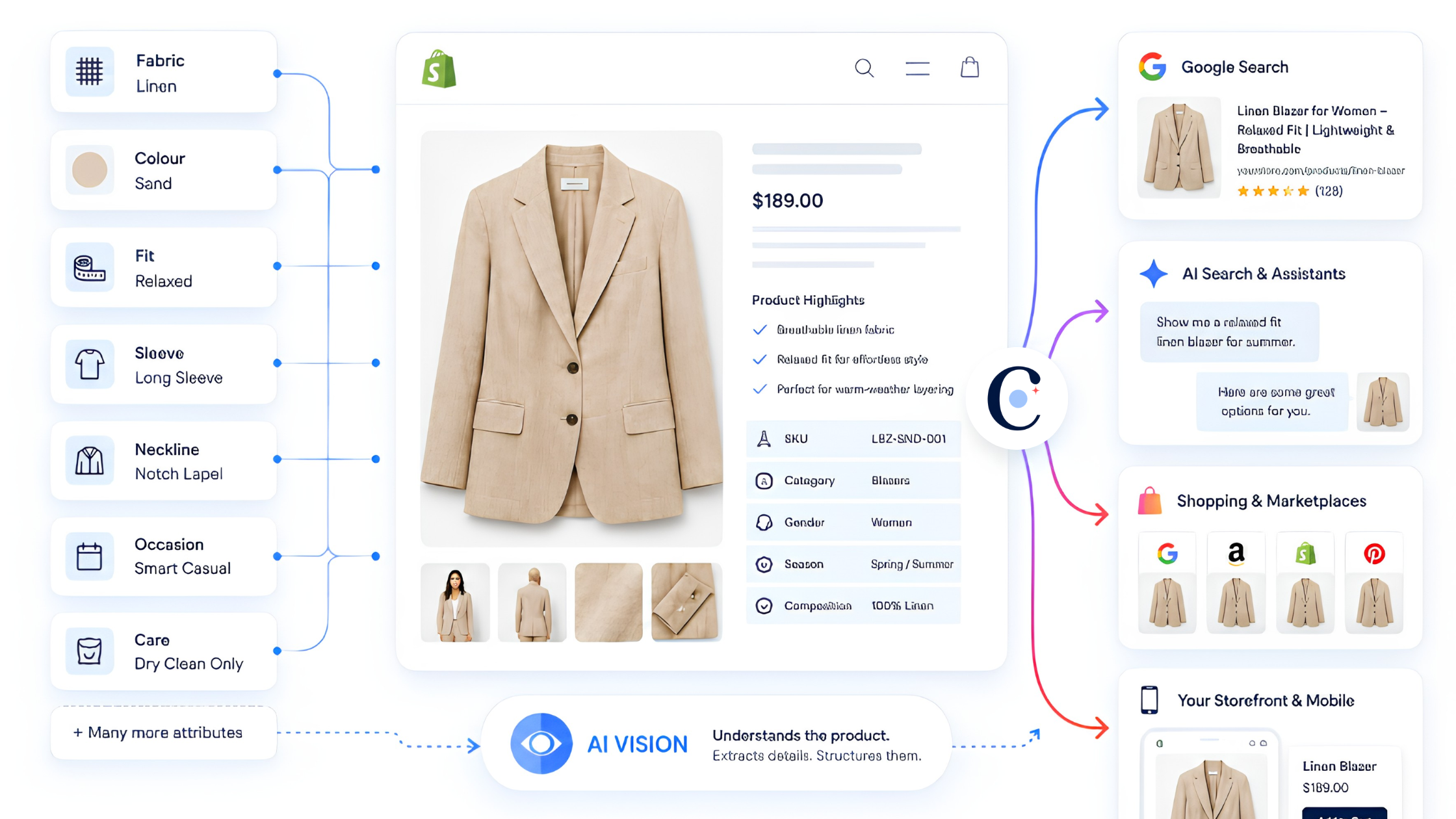
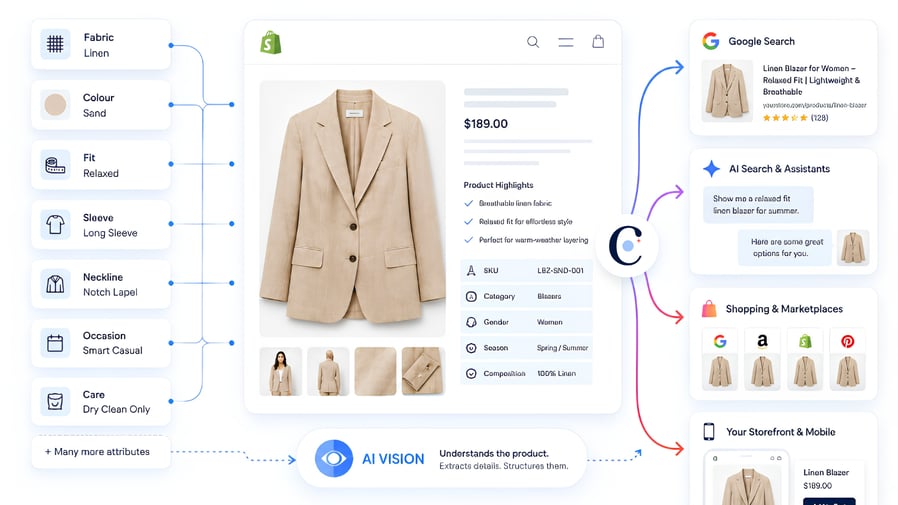
For years, e-commerce teams have focused on driving more traffic, from better SEO, to ads, and social media content.
But something fundamental has changed.
Both people and AI are searching for products.
Google AI Overviews, ChatGPT, Gemini, Claude and AI-powered shopping assistants are all becoming part of the customer journey. Instead of typing keywords, shoppers are asking questions.
"Show me a lightweight linen dress for a holiday."
"Find a relaxed-fit men's overshirt under $150."
The quality of the answer depends on the quality of the product data behind it. That's why better product data on and within a product page is becoming one of the biggest competitive advantages for Shopify stores.
Product data is more valuable than product copy
A product description is only one piece of the puzzle. To understand a product properly, search engines and AI platforms need structured information, including:
- Product type
- Colour
- Fabric
- Fit
- Sleeve style
- Neckline
- Pattern
- Occasion
- Product attributes
- Image alt text
- SEO metadata
- Search and collection tags
The richer and more accurate this information is, the easier it is for potential customers, and AI engines and agents to discover your products.
This isn't just about ranking on search engines anymore. It's about being recommended wherever shoppers search.
Product data is the source of truth. Product content is the end result.
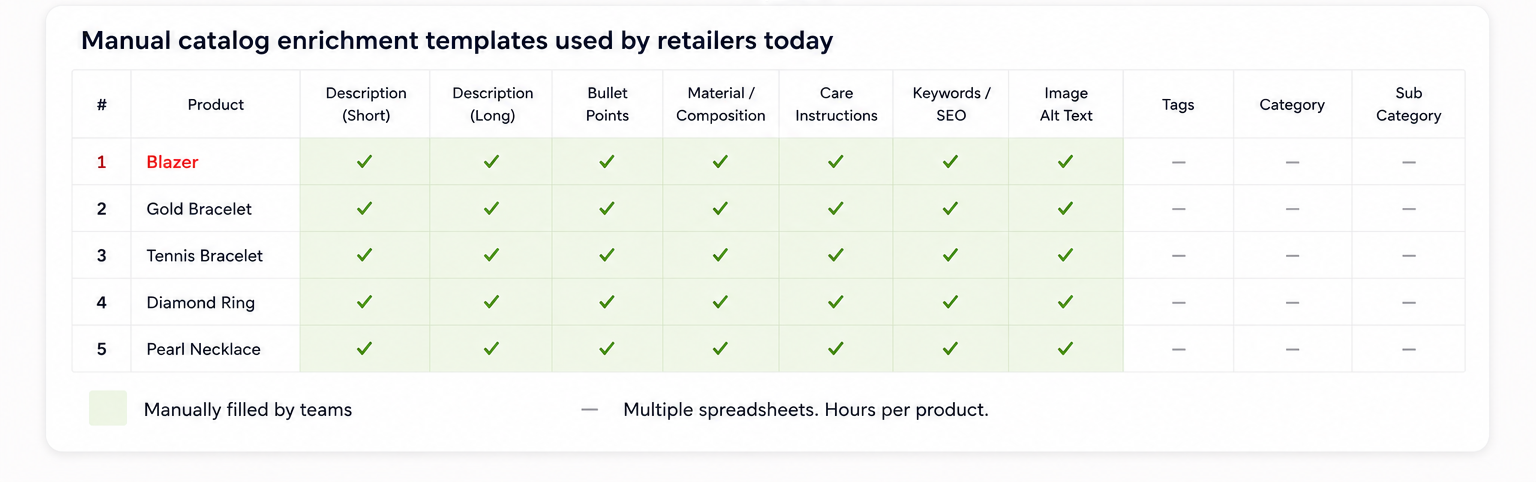
Most Shopify retailers still follow a surprisingly manual process.
Product information arrives from suppliers > Teams work through spreadsheets > Content is copied between systems > Descriptions are written > SEO fields are completed > Tags are added > Someone manually reviews everything before the product finally goes live.
For many retailers, this process takes more than two hours for every SKU. That might be manageable for a handful of products. It isn't scalable, however, when you're launching hundreds or thousands every season.
Current processes yield:
- Slower product launches
- Higher operational costs
- Inconsistent product content
- Missed SEO and AI engine optimization opportunities
- Inefficient and repetitive admin tasks by valuable ecommerce teams, instead of their energy going into growing your business.
Why generative AI alone doesn't solve the problem
Generative AI has made writing content faster. But its resulting quality still depends on the quality of the information it's given. For example, ff the prompt is incomplete, the output will be too. Likewise, if the underlying data is incomplete, the results won't give the full product picture.
That's because large language models don't truly understand your products. They don't reliably identify construction details, fabrics, fit, or design features unless that information already exists.
When details are missing, the AI fills the gaps, sometimes correctly, but a lot of times not.
Retailers still end up checking, editing and correcting the output. The bottleneck simply moves further down the workflow.
Product knowledge is built into Catecut
At Catecut, we believe better content starts with better product understanding. Before generating a single sentence, Catecut uses its AI Vision technology to analyze product images and identify the design details that matter.
It recognises features such as:
- Garment type
- Colour
- Fabric
- Fit
- Sleeve style
- Neckline
- Pattern
- Design details
That structured product data (product categories and design attributes) becomes the foundation for everything else, including your product titles and descriptions, SEO tags and metadata (image and video alt text), and multilingual product pages.
Instead of asking large generative AI to guess, Catecut gives your store the product content and information it needs to publish accurate, consistent product pages at scale.
Better product data creates better business outcomes
When product data improves, everything downstream improves too. Products are published faster. Content structure and branding stays consistent across pages. SEO becomes stronger because important attributes aren't overlooked. AI-powered search tools have richer information to understand and recommend.
Most importantly, your e-commerce team spends less time on repetitive manual work and more time on launching products and growing the business.
The future belongs to retailers with the best product data
AI isn't replacing e-commerce teams. It's changing what customers expect—and how products are discovered. The retailers that succeed won't necessarily be the ones using the most AI.
They'll be the ones with the richest, most accurate and most consistent product data.
That's the competitive advantage.
See How Catecut Impacts Your Own Store
The best way to understand the impact is to measure it.
Choose a plan that fits your catalog. Start with a 7-day free trial and pick SKUs from your Shopify catalogue.
Compare your current workflow with Catecut and measure:
- Time per published SKU
- Cost savings on content and e-commerce logistics spends
- Product publishing speed
- Content consistency across pages
- SEO and AEO improvements
- Overall product discoverability
Better product data isn't just about publishing faster. It's about operating an online store primed for modern e-commerce.
Related Posts

1.png?width=400&upsize=true&name=Shopify%20Catecut%20Page%20banner%20(1600%20x%20900)1.png)